
Resonance and Resilience: Helping Bereaved Couples Cope with Traumatic Loss
Viewed through the lens of meaning-focused grief therapy, adapting to life-altering losses or transitions of any kind entails reaffirming or reconstructing a world of meaning that has been shaken or shattered by traumatic events. However, meaning arises between us as well as within us, particularly in the co-construction of the significance of the loss in […]
Grief & the Expressive Arts: Activating the Creative Imagination
Significant loss, including but not limited to bereavement, can disrupt our practical identities, dislodge relationships with others, and alter our experience of belonging in place and time. Adaptive grieving involves reconstructing a world of meaning that is enacted in the physical and social environment and shaped by cultural scripts. Aesthetic activities are embodied and help […]
Children’s Grief: Retelling the Death Story As An Active Agent
Traditional theories of childhood grief have largely relied on stage-based developmental frameworks, often linking children’s understanding of death to age-related cognitive capacities. Such approaches may imply that children grieve in predictable, normative ways, thereby overlooking the child’s individuality, relational context, and lived experience. This module challenges these assumptions by introducing a Transactional Developmental Model of […]
Widow’s Fire: Embodied Grief & Longing after Sexual Loss
Young widows, who are typically defined as being 50 years old or younger, confront many unique complexities that warrant attention. Much of the clinical literature about widowhood is derived from older widows; it does not fully capture the experiences of young widows, who usually face an untimely and traumatic loss. In this module, we will […]
Titrating Trauma, Rescuing Relationship: Clinical Strategies for Addressing Tragic Death

When a significant person dies by suicide, homicide, overdose or fatal accident, mourners often need more than the informal support systems in their lives can provide, calling for specialist intervention. And yet many professionals struggle to meet the daunting challenges that such violent and unnatural deaths pose, not only to the survivors but also to […]
Writing for Wellbeing

Grief is widely recognised as one of the most challenging and emotionally painful experiences we may face. Such an intense experience calls for a wide and varied range of methods that allow therapists, counselors, psychologists and social workers to support the individual needs of their clients. This module introduces Writing for Wellbeing (WFW) as one […]
Grief Therapy Learning Retreat
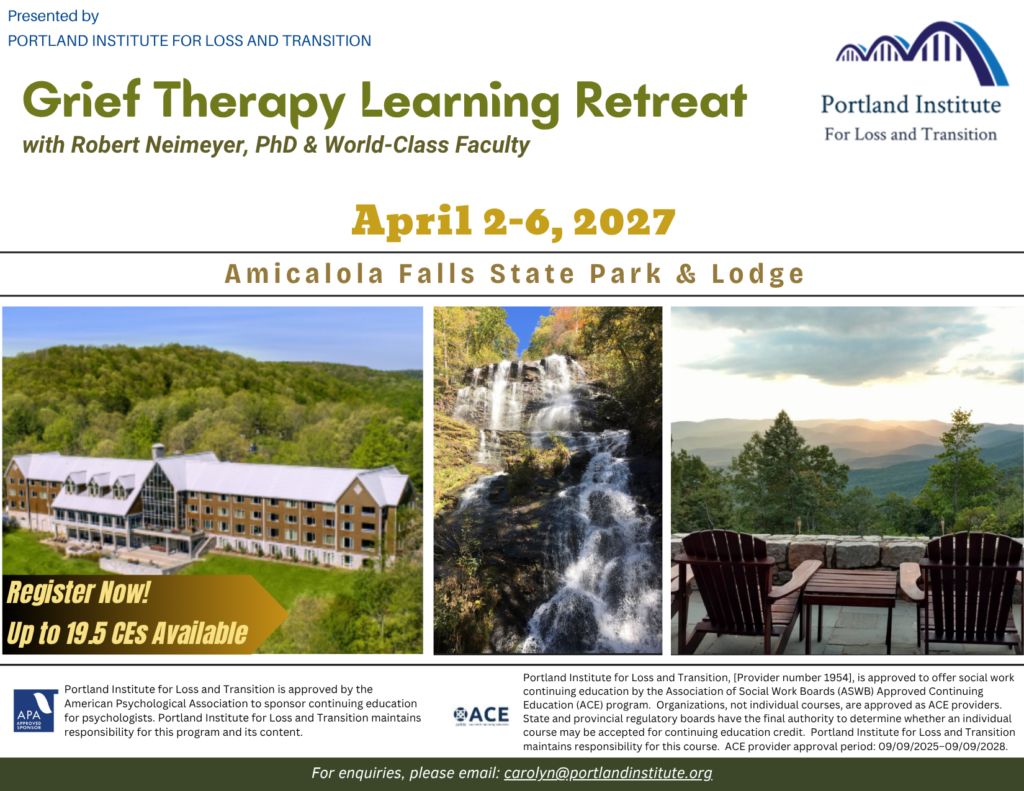
Join us in Amicalola Falls State Park and Lodge, Dawsonville, GA, USA, for our 5-Day / 4-Night Grief Therapy Learning Retreat that offers close access to a selection of internationally renowned Portland Institute faculty and guest speakers, who provide substantial training in the latest research and practice on meaning-oriented grief therapy approaches. Drawing on a […]
Mourning to Meaning: Advanced Dialogic Practices in Grief Therapy
January 18-19, 2027 Singapore Presented by REGISTER NOW EARLY BIRD till December 7, 2026 Just SGD$900 for 2-day workshop! (Inclusive of lunch & 2 tea breaks) Earn Credits for 2 Case Studies Lessons and 2 Practicum Lessons toward Certification in Meaning-Focused Grief Therapy or Certification in Grief Therapy for Traumatic Loss Offered by the Portland Institute. […]
Writing Through Bereavement
Although retelling the “event story” of the death in an atmosphere of responsive witnessing represents a core component of Meaning Reconstruction, it is only one of a great variety of narrative procedures that can be used by grief therapists. In this workshop we explore the possible role of a sample of creative techniques in which […]
Transcending Taboos: Rewriting the Self in Grief
While sadness is readily sanctioned in bereavement, other less comfortable emotions such as anger, regret, relief, guilt, joy, and desire are frequently considered taboos by those facing loss. Because research shows that a much larger pallet of feelings is common in those who are grieving, this module uses writing techniques to enlarge the space for […]